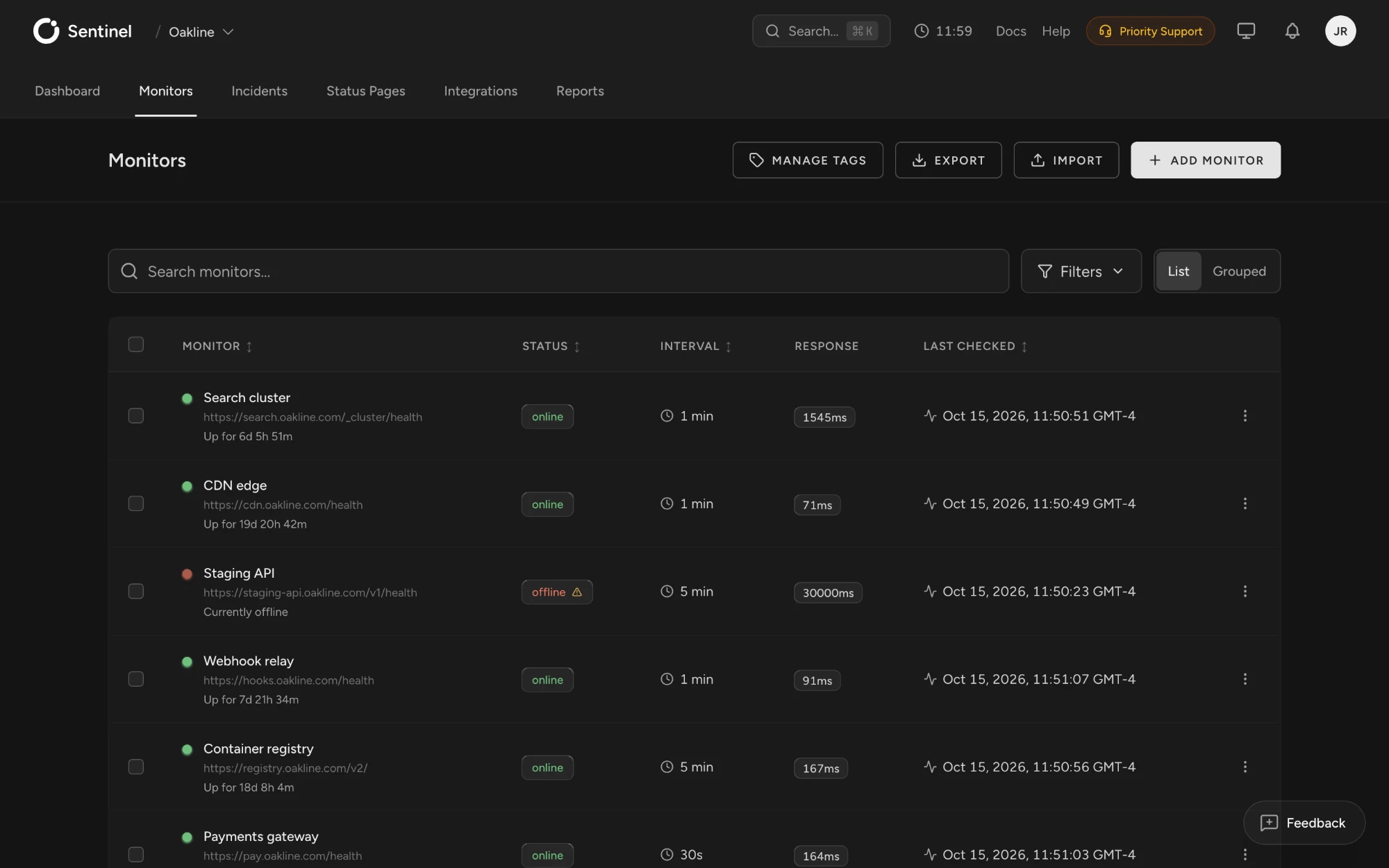
Sentinel is a global uptime and infrastructure monitoring platform. Rootstuff designed it, built it, and runs it in production, which makes it the clearest evidence on this site of what the studio does when the brief is an application rather than a website.
The brief
It started as an internal need. Every maintenance plan the studio sells carries the same promise, that we notice before your customers do, and the monitoring tools we tried kept breaking that promise in one of two ways. Some watched one thing well and missed the rest: uptime but not certificates, response codes but not DNS. Others watched everything and buried the one signal that mattered under dashboards nobody opened twice. We wanted the whole picture for every property in our care, and we wanted it quiet.
So we built it the way we'd build it for a client, and then kept going until it was a product.
The build
Sentinel is a Laravel application with a Vue and Inertia front end. The checks themselves don't run from the app server. They run from a fleet of probe workers written in Go, spread across 15 regions on six continents, so a check against a site in Singapore is made from Singapore and a site in Frankfurt from Frankfurt, with the rest of the world watching too.
That geography is the point. A single vantage point can't tell a real outage from its own bad route, so Sentinel confirms outages across regions before it opens an incident or sends an alert. You hear about the problem, not about one network's bad afternoon.
What it watches:
- HTTP uptime and response health, at intervals down to 30 seconds, with keyword and status checks so a page that loads but is wrong still counts as down.
- SSL certificates, with warnings long before expiry, because an expired certificate is the most preventable outage on the internet.
- DNS, recorded as history, so a wrong or hijacked record is caught as a change rather than discovered as a mystery.
- Domain expiry, the outage nobody monitors until it happens.
- Ping and ports, for the infrastructure behind the website: databases, mail, queues, anything with an address.
- Heartbeats, for scheduled jobs and queue workers that have to check in, so a cron that quietly stopped is noticed the first time it misses.
- Performance over time, because slowness is usually the first chapter of downtime.
Around the checks sits the operational layer a team actually needs. Incidents open when the regions agree and resolve when they agree again, with acknowledgement and a timeline. Alerts go out through email, Slack, webhooks and the other channels teams already live in. Public status pages let customers see what the team sees. Monitors are grouped and tagged, imported and exported in bulk, and shared across team workspaces with roles and two-factor enforcement.
Sentinel is also built to be driven by software. Everything in the dashboard is available through an API with scoped tokens, and through an MCP server, so an engineer's AI assistant can ask "is anything down?", acknowledge an incident, or probe a URL from every region with the same permissions as the person asking.
Running it
Building a SaaS platform is one discipline. Operating one is another, and operating this one has shaped how the studio works for every client.
Sentinel deploys many times a week without downtime. Its workers are rolled region by region. Its queues, scheduler and failed jobs are watched by tooling we wrote for the purpose, and that tooling became Laravel Ops MCP, an open-source package that gives any Laravel application the same read-only operator view. Every opinion Rootstuff holds about deployments, monitoring and maintenance was tested on Sentinel first, usually at an inconvenient hour.
Where it lives now
Sentinel outgrew the studio. It's a product with its own free plan, used by developers and DevOps teams who need to know when something breaks, wherever it breaks, and by agencies and freelancers responsible for other people's sites. If that's you, start with Sentinel's website monitoring for agencies, or read how it compares to UptimeRobot.